


Buyers find the category, not your brand.
They search the product type and land on a marketplace that sells everyone. Your brand — and your dealer locator — never enters the picture.
Built for retail / manufacturing
You’re a retailer or product brand whose growth depends on being discovered — by end customers, by dealers, by retail partners, by wholesale buyers. Word-of-mouth and trade shows aren’t enough anymore. You need a brand presence and a competitive-analysis-driven SEO program that gets your products and dealer locator in front of buyers before competitors do.
Retail / Manufacturing
Buyers find your brand first, then your nearest dealer.
What we lead with
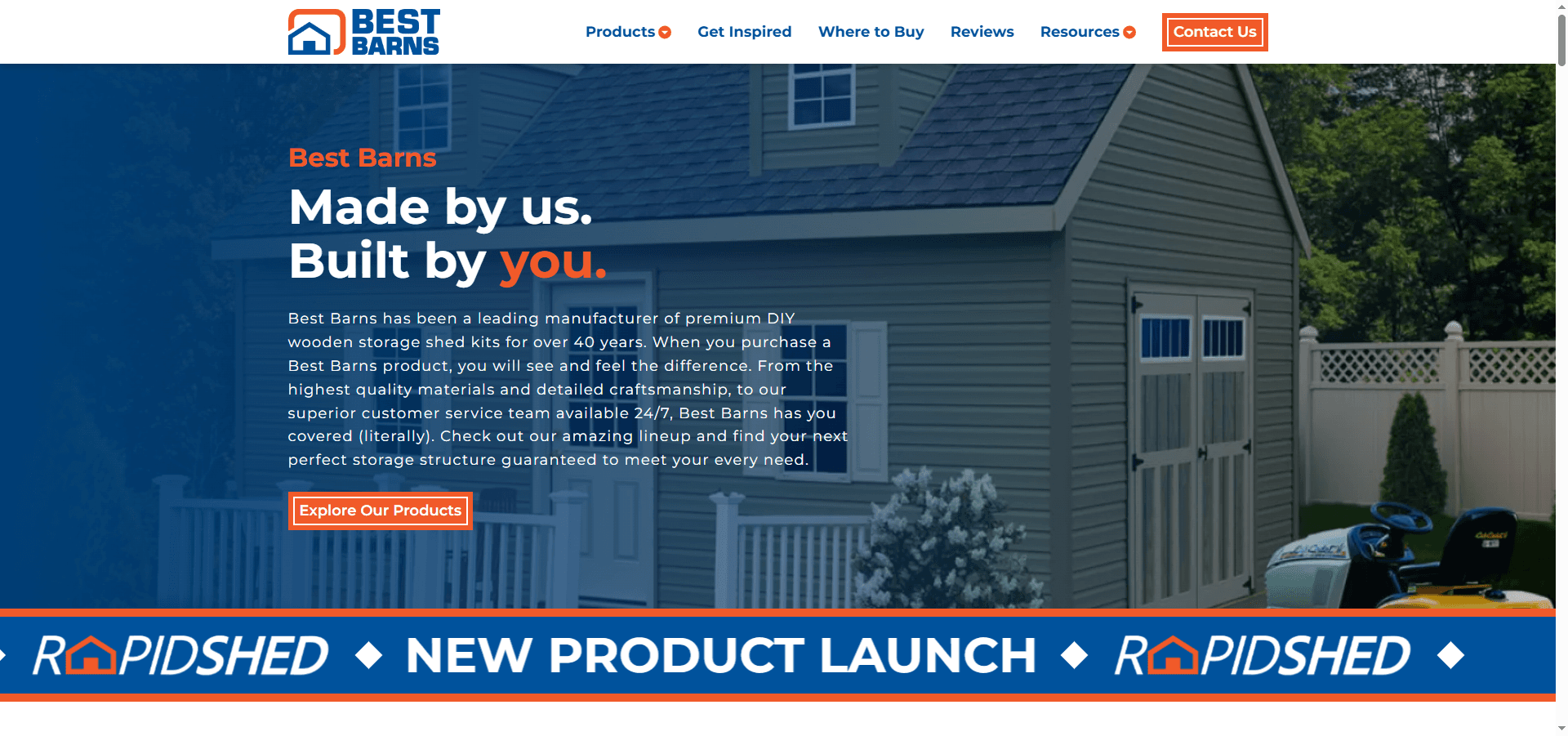 Shipped in retail / manufacturingBest Barns
What usually goes wrong
They search the product type and land on a marketplace that sells everyone. Your brand — and your dealer locator — never enters the picture.
The channels that built the company don’t scale past the people in the room. The next leg of growth has to come from buyers who’ve never heard your name.
Your dealer network is only as strong as the demand pointed at it. With no top-of-funnel, there’s nothing for partners to convert.
How we approach it
Product, proof, and a dealer locator that routes a buyer to the nearest partner instead of a dead end.
We map who ranks for your product terms, where their coverage is thin, and take the gaps they left open.
Top-of-funnel content plus local SEO, so every dealer gets buyers — not just a listing on a map.
What a retail / manufacturing engagement covers
Proof
“Respectful, openminded, professional, and extremely knowledgeable — these are the core attributes that have made my experience a positive one. They built our company a new website and since then have been diligently working on SEO initiatives. We’re already seeing favorable results! I highly recommend Frontend Horizon.”
The system behind it
Every retail / manufacturing engagement runs the same five-phase process. The first two phases are free — you see the read on your market before any build is quoted.
Phase 1
Census
Pull US Census + ACS + County Business Patterns scoped to your geo and NAICS.
Ships: Market Frame Report
Phase 2
Public Data
Overlay state filings, property records, review platforms, and license boards to find people inside the frame who are actually active.
Ships: Audience Map
Phase 3
ICPs
Build a card for each audience cluster. Demographics, signals, triggers, sales cycle, channel preference.
Ships: ICP card set (3-7 cards)
Phase 4
System
Tailor the marketing system to each ICP. Offers, sequences, content, attribution, reporting.
Ships: Working marketing system
Phase 5
Sprint
Execution in sprints with a named outcome per sprint. Continuous reporting and rebalance.
Ships: Named outcome per sprint
Questions retail / manufacturing ask first
The opposite. The site captures demand and routes it to the nearest dealer via the locator. You generate the lead, they close it, and both numbers go up.
Technical terms are easier, not harder — less competition, clearer intent. We rank you for the exact spec language your buyer types.
It tells you which product terms competitors own, which they’ve ignored, and where their dealer coverage is thin. That’s your map for where next quarter’s spend goes.
Field guides
Real solutions you can run yourself, each built on open public data. Ordered for retail / manufacturing first.
Google publishes how fast your site really is for real users, and your competitors' too. Here is how to read that field data for free and fix the biggest offender first.
If you sell to businesses, the government already published a map of where your buyers work. Here is how to read BLS QCEW and Census LEHD to find the counties and corridors where your industry concentrates.
Ten locations do not rank as one brand. They rank as ten local businesses. Here is how to build a real page for each one, backed by the census read for its area and its own claimed profile.
You can reverse-engineer a competitor's SEO from artifacts they publish for free. Here is how to read the search results, their sitemap, and their schema, then build a coverage-gap map you can attack.
Stop pricing on a gut feel. Public income, competitor, and wage data can tell you what your market can bear, how crowded it is, and where to plant your flag.
The federal government already mapped your market for free. Here is how to read the American Community Survey and let it decide where your marketing money goes.
The government already sorted every business in the country into a free, numbered taxonomy. Learn to name your buyer by code, and every other public dataset opens.
Demand for most local services runs on a season, and Google Trends shows you the shape of that season for free. Here is how to read the curve and turn it into a calendar.
If you sell to other businesses, the Census already counted your buyers. Here is how to read County Business Patterns and turn it into a real account list and a territory plan.
Google hands you your own search data for free. Here is how to read the Search Console Performance report to find the queries you rank for but do not win, and turn each one into a fix.
Schema.org is a free, shared vocabulary that tells search engines and AI answer engines exactly what your pages mean. Here is which structured data a service business needs, and how to add it without touching code you cannot validate.
The map pack is the most valuable free local surface you own. Here is how to work Google's three published ranking factors and earn one of those three spots.
Not quite you?
3 sprint kickoff slots open this quarter
Buyers find your brand first, then your nearest dealer.
Eight minutes of discovery, no sales call. We pull the census and public data on your geo and draft the ICP cards before any contract.