
You pay for tire-kickers, not buyers.
HomeAdvisor and Angi invoice you for shower-repair price-shoppers while the $1.2M remodel googles a custom-home builder and finds your competitor. You’re renting the wrong leads.
Built for construction
You’re a builder, GC, or specialty trade who used to get junk leads from aggregators and a website nobody could find. You want a digital presence that puts million-dollar projects in front of you, not bottom-of-the-barrel pricing wars. The site has to do the credibility work; the SEO has to put you in front of the right buyer; the lead form has to filter out the tire kickers.
Construction
Leads for the build you want — not the repair you don’t.
What we lead with
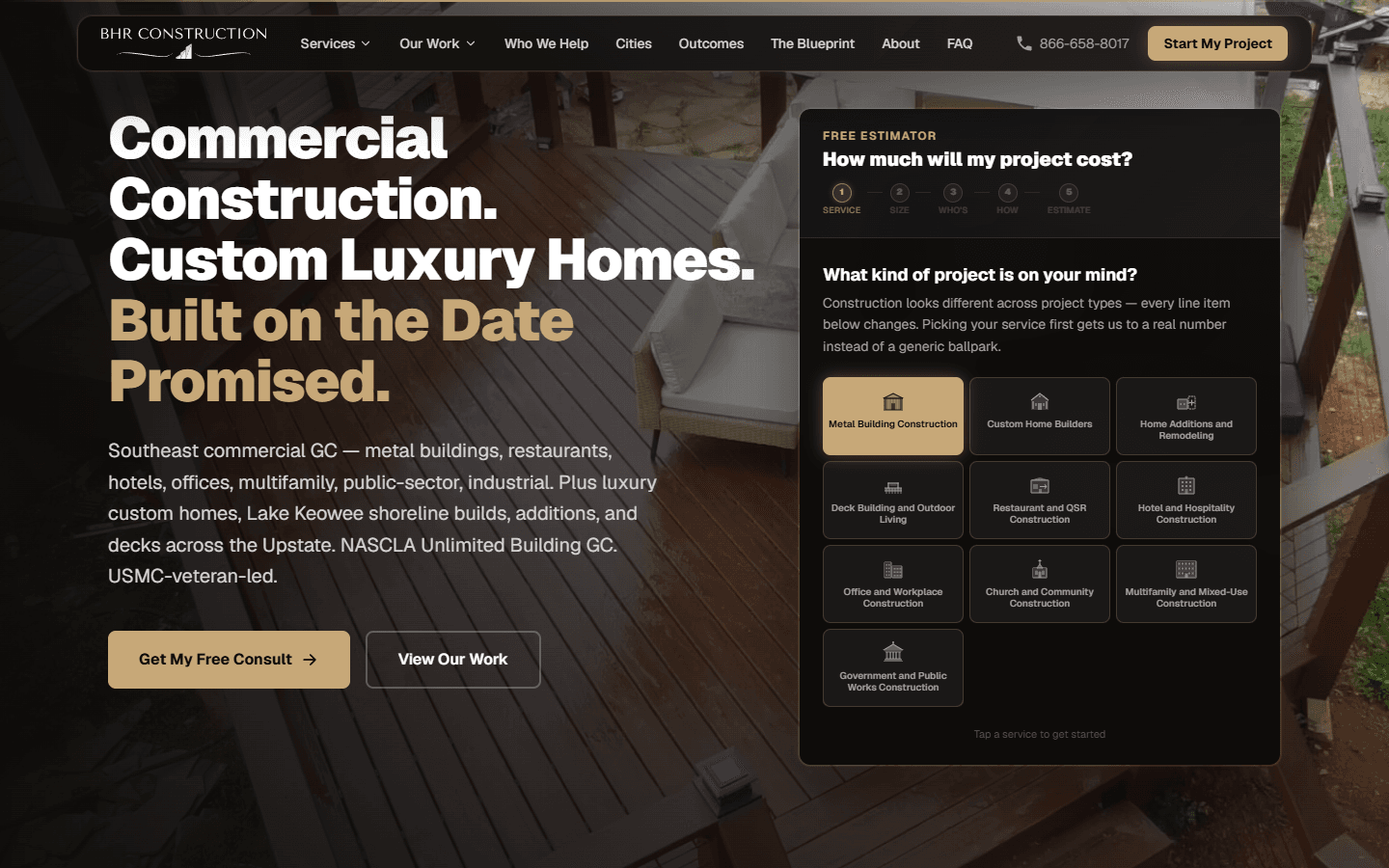 Shipped in constructionBHR Construction
What usually goes wrong
HomeAdvisor and Angi invoice you for shower-repair price-shoppers while the $1.2M remodel googles a custom-home builder and finds your competitor. You’re renting the wrong leads.
A buyer about to spend seven figures wants proof you’ve done it. A 2018 template with stock photos and no real project gallery quietly tells them you haven’t.
You rank for ‘handyman near me.’ The high-margin client types a different query — and you’re on page four for the work that actually pays.
How we approach it
Real project pages, real photos, budgets named where you can name them. Credibility qualifies the buyer before the form ever does.
We map the queries a high-margin buyer actually types and rank you for those — not the repair work that’s been finding you by accident.
Budget and scope questions up front, so the inbox fills with projects worth a callback instead of noise to triage.
What a construction engagement covers
Proof
“I work with Frontend Horizon on SEO and social media marketing, which has been great. I used to get leads for shower repair. Now I get leads for building million dollar custom homes. Love the work they have done and continue to do for me.”
The system behind it
Every construction engagement runs the same five-phase process. The first two phases are free — you see the read on your market before any build is quoted.
Phase 1
Census
Pull US Census + ACS + County Business Patterns scoped to your geo and NAICS.
Ships: Market Frame Report
Phase 2
Public Data
Overlay state filings, property records, review platforms, and license boards to find people inside the frame who are actually active.
Ships: Audience Map
Phase 3
ICPs
Build a card for each audience cluster. Demographics, signals, triggers, sales cycle, channel preference.
Ships: ICP card set (3-7 cards)
Phase 4
System
Tailor the marketing system to each ICP. Offers, sequences, content, attribution, reporting.
Ships: Working marketing system
Phase 5
Sprint
Execution in sprints with a named outcome per sprint. Continuous reporting and rebalance.
Ships: Named outcome per sprint
Questions construction ask first
We can’t switch HomeAdvisor off, but we make your own site and search the cheaper, better channel — so the leads you own outnumber the ones you rent. Most builders we work with wind aggregator spend down inside two quarters.
Referrals still check you online before they call. A site that looks like the work you do protects the referral; it doesn’t replace it. The SEO is what adds the buyers a referral never reaches.
Site credibility helps the day it ships. SEO compounds — first movement in 60–90 days, real ranking on the money queries by month six. We report the leading indicators monthly so you’re not guessing.
Field guides
Real solutions you can run yourself, each built on open public data. Ordered for construction first.
Google hands you your own search data for free. Here is how to read the Search Console Performance report to find the queries you rank for but do not win, and turn each one into a fix.
Stop pricing on a gut feel. Public income, competitor, and wage data can tell you what your market can bear, how crowded it is, and where to plant your flag.
The federal government already mapped your market for free. Here is how to read the American Community Survey and let it decide where your marketing money goes.
Demand for most local services runs on a season, and Google Trends shows you the shape of that season for free. Here is how to read the curve and turn it into a calendar.
The map pack is the most valuable free local surface you own. Here is how to work Google's three published ranking factors and earn one of those three spots.
Google publishes how fast your site really is for real users, and your competitors' too. Here is how to read that field data for free and fix the biggest offender first.
If you sell to businesses, the government already published a map of where your buyers work. Here is how to read BLS QCEW and Census LEHD to find the counties and corridors where your industry concentrates.
Ten locations do not rank as one brand. They rank as ten local businesses. Here is how to build a real page for each one, backed by the census read for its area and its own claimed profile.
You can reverse-engineer a competitor's SEO from artifacts they publish for free. Here is how to read the search results, their sitemap, and their schema, then build a coverage-gap map you can attack.
Schema.org is a free, shared vocabulary that tells search engines and AI answer engines exactly what your pages mean. Here is which structured data a service business needs, and how to add it without touching code you cannot validate.
The government already sorted every business in the country into a free, numbered taxonomy. Learn to name your buyer by code, and every other public dataset opens.
If you sell to other businesses, the Census already counted your buyers. Here is how to read County Business Patterns and turn it into a real account list and a territory plan.
Not quite you?
3 sprint kickoff slots open this quarter
Leads for the build you want — not the repair you don’t.
Eight minutes of discovery, no sales call. We pull the census and public data on your geo and draft the ICP cards before any contract.